As an Amazon Associate we earn from qualifying purchases. This doesn’t affect which products we recommend.
Hamsters are far more active than most people realize. In the wild, hamsters run up to 5-8 miles per night. That means the small, colorful cages sold in most pet stores — while visually appealing — are woefully inadequate for an animal with that level of energy and need for exploration.
The good news: proper hamster housing has never been more accessible or affordable. We’ve rounded up the best hamster cages in 2026 so your hamster can thrive the way nature intended.
How much space does a hamster actually need?
Hamster welfare organizations recommend a minimum of 450 square inches of unbroken floor space — that’s roughly 40″ x 20″ or equivalent. Many popular cages sold in pet stores fall far below this.
Beyond floor space, hamsters need:
- Deep bedding — at least 6 inches, ideally 10-12 inches, for burrowing. Burrowing is a core hamster behavior and denying it causes chronic stress.
- A large wheel — minimum 10″ diameter for Syrian hamsters, 8″ for dwarf hamsters. Wheels with solid running surfaces only — mesh or barred wheels injure feet and spines.
- Hiding spots — hamsters are prey animals and need somewhere to feel safe
- Good ventilation — hamsters are sensitive to ammonia buildup from waste
- Secure latches — hamsters are escape artists
Syrian vs. dwarf hamsters — does it matter for cage choice?
Yes. Syrian hamsters are significantly larger than dwarf species (Roborovski, Campbell’s, Winter White) and need more space and larger accessories. All size recommendations in this guide are for Syrian hamsters unless otherwise noted. Dwarf hamsters can use slightly smaller setups but still benefit from as much space as possible.
Our top picks for 2026
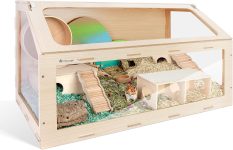
1. Niteangel Vista Hamster Cage — Best Overall
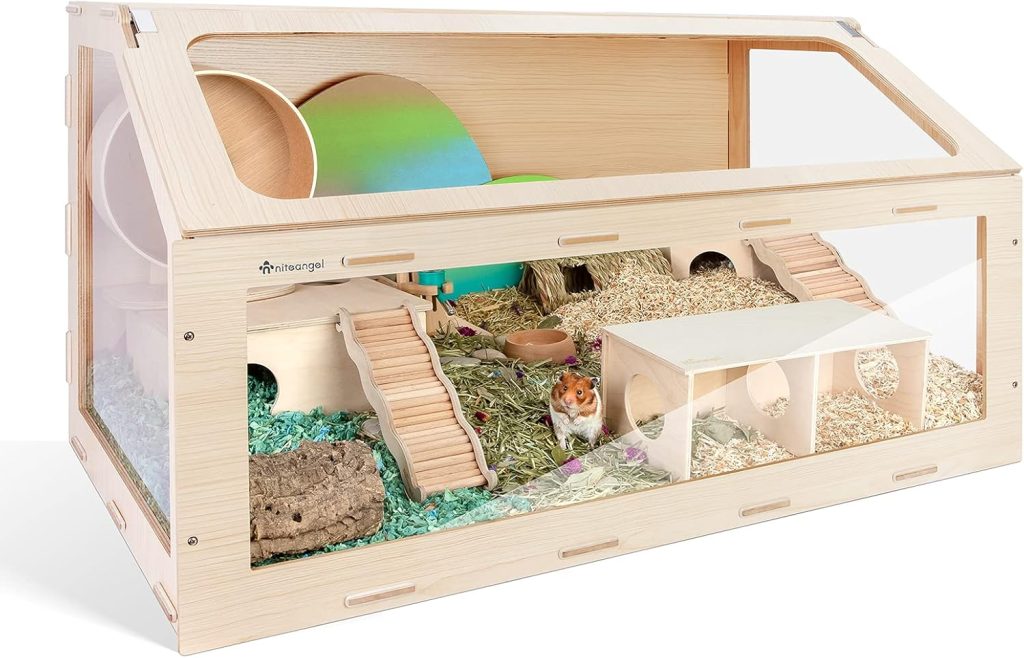
Why we love it: The Niteangel Vista has become the favorite of the hamster community for good reason. The large glass front panel gives a stunning view of your hamster’s natural behaviors — burrowing, foraging, and exploring — while the deep base (available in 8″ and 12″ depth versions) allows proper burrowing depth. The mesh top provides excellent ventilation.
At 40″ x 20″, it meets welfare minimums for Syrian hamsters with room to spare. The side door and top opening make access easy, and the quality of construction is excellent. This is a cage you buy once and don’t replace.
- Floor space: 800 sq inches
- Depth for bedding: 8″ or 12″ (choose the deeper version)
- Best for: Syrian and dwarf hamsters, serious owners, display setups
- Available at: Shop Niteangel Vista on Amazon
2. Midwest Critterville Arcade — Best Budget Cage
Why we love it: The Midwest Critterville Arcade is one of the few budget cages that actually meets minimum welfare standards. The 41.5″ x 17.9″ footprint gives 743 square inches of floor space, the deep base holds adequate bedding, and the wire top provides good ventilation. Multiple access points make cleaning and interaction easy.
Not as visually stunning as the Niteangel, but a solid, functional cage at a much lower price point. A good choice for first-time hamster owners who want to do right by their pet without a large upfront investment.
- Floor space: 743 sq inches
- Best for: First-time owners, budget shoppers, Syrian hamsters
- Available at: Shop Midwest Critterville on Amazon
3. Niteangel Multi-Chamber Hamster Cage — Best for Enrichment
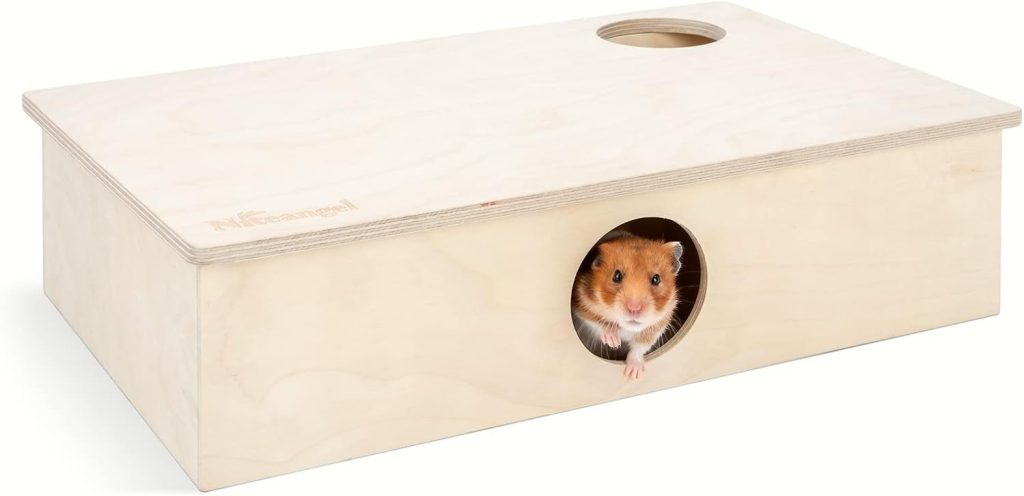
Why we love it: The Niteangel Multi-Chamber cage is designed to mimic the complex burrow systems wild hamsters create. Multiple chambers connect via tunnels, giving hamsters a sense of a real burrow network. The transparent panels let you watch your hamster navigate between chambers — endlessly entertaining.
This cage excels at providing psychological enrichment beyond just floor space. If you want a hamster that displays its full range of natural behaviors, this is one of the most enriching setups available.
- Best for: Enrichment-focused setups, watching natural behaviors
- Available at: Shop Niteangel Multi-Chamber on Amazon
4. Ferplast Hamster Cage Favola — Best for Dwarf Hamsters
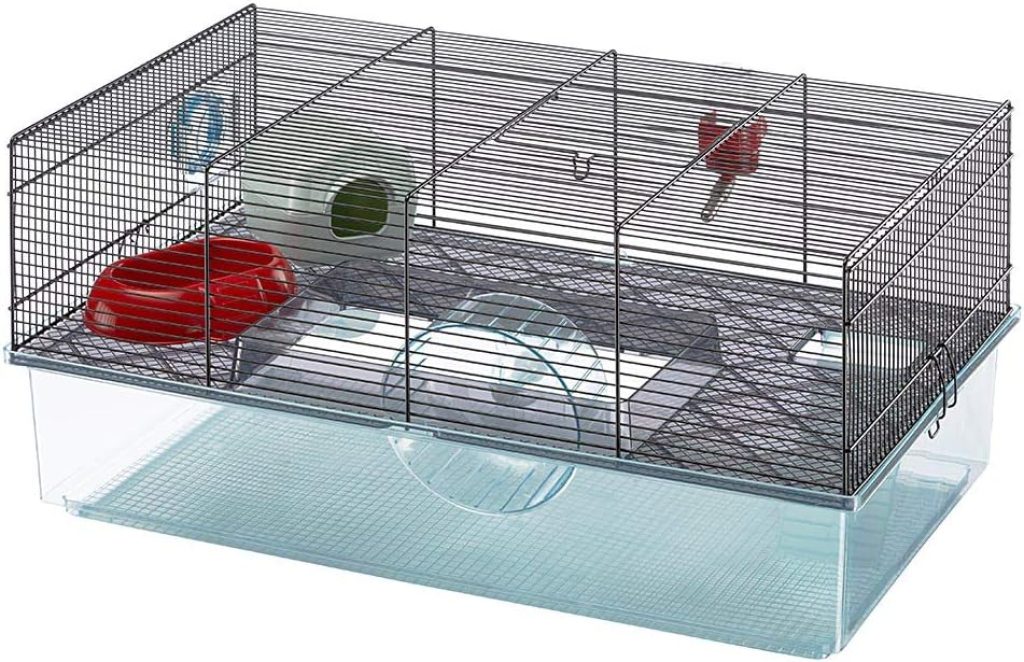
Why we love it: While Syrian hamsters need the larger cages above, dwarf hamster species can do well in slightly more compact setups — and the Ferplast Favola is one of the best options for dwarf owners. The two-level design maximizes usable space, the deep base holds adequate bedding for smaller species, and the included accessories (wheel, water bottle, food dish, hideout) are decent quality for a starter setup.
Not suitable for Syrian hamsters, but a well-designed home for Roborovski, Campbell’s, or Winter White dwarf hamsters.
- Floor space: 357 sq inches
- Best for: Dwarf hamsters only, beginners
- Available at: Shop Ferplast Favola on Amazon
5. IKEA Detolf Hack — Best DIY Option
Why we love it: The IKEA Detolf is a glass display cabinet that the hamster community has repurposed into one of the most popular hamster enclosures in the world. Laid on its side, it provides over 800 square inches of floor space, a beautiful glass viewing panel, and enormous depth for bedding. At around $80, it’s exceptional value for the space it provides.
You’ll need to add a mesh top for ventilation (custom ones are available on Etsy) and all accessories separately, but the result is a stunning, spacious enclosure at a fraction of the cost of dedicated hamster cages of comparable size.
- Floor space: ~800+ sq inches when modified
- Best for: DIY-inclined owners, maximum space on a budget
- Available at: Find at IKEA
Essential accessories for your hamster cage
Wheel: The most important accessory. Use a solid-surface wheel — never mesh or barred. Minimum 10″ diameter for Syrians (the Niteangel Wheel and Wodent Wheel are both excellent), 8″ for dwarfs. The wheel should be large enough that your hamster runs with a straight or slightly upward curved back — not arched downward.
Bedding: Deep paper bedding is ideal — Carefresh, Kaytee Clean & Cozy, or unscented paper pellets. Aim for at least 6 inches depth, more if possible. Never use cedar or pine shavings — the aromatic oils are harmful to hamsters’ respiratory systems.
Hideout: A wooden or ceramic hide gives your hamster a safe sleeping spot. Multi-chamber wooden houses are particularly popular.
Sand bath: Hamsters groom themselves using fine sand — a small dish of chinchilla sand (not dust) placed in the cage lets them maintain their coat naturally.
Food dish and water bottle: Heavy ceramic bowls prevent tipping. A drip-free water bottle is convenient, but some hamsters prefer a shallow water dish — offer both and see which your hamster uses.
Enrichment: Chew toys, wooden tunnels, cardboard tubes, digging boxes, and foraging opportunities keep hamsters mentally stimulated. Scatter feeding (hiding food throughout the bedding) encourages natural foraging behavior.
What to feed a hamster
Hamsters are omnivores and do best on a varied diet:
- Pellet mix or seed mix as a base — look for hamster-specific mixes without added sugar or artificial colors
- Fresh vegetables in small amounts — broccoli, cucumber, carrot, leafy greens
- Protein occasionally — plain cooked chicken, mealworms, or hard-boiled egg
- Fresh water always available
Avoid: citrus fruits, onions, garlic, chocolate, sugary treats, and anything with artificial additives.
How long do hamsters live?
Syrian hamsters typically live 2-3 years. Dwarf species live slightly shorter lives on average — 1.5-2.5 years. Proper housing, diet, and enrichment all contribute to reaching the upper end of these ranges.
Final thoughts
The Niteangel Vista is the best hamster cage available in 2026 — the combination of proper floor space, deep bedding capacity, beautiful design, and quality construction makes it the cage we’d recommend to every hamster owner. For budget-conscious owners who still want to meet welfare standards, the Midwest Critterville Arcade is a solid alternative. And for the truly dedicated DIY owner, the IKEA Detolf hack delivers maximum space at minimum cost.
Your hamster will spend its entire life in its cage. Getting the housing right is the single most impactful thing you can do for its wellbeing.
This post contains Amazon affiliate links. When you purchase through our links, we may earn a small commission at no extra cost to you. We only recommend products we genuinely believe in.
Published by Fit Paws Club — your trusted source for quality pet supplies. Fit Paws Club is the sister brand of Chef Kitty, makers of premium freeze-dried cat and dog treats.